
Why Do Commercial Kitchen Floors Stay Greasy Even After Mopping?

Updated: 1 day ago
Mopping a commercial kitchen floor every day does not always mean the floor will stay clean. Restaurant, café, bakery, and other business kitchens deal with cooking oils, food spills, crumbs, moisture, and constant foot traffic throughout the day. Grease can gradually settle on the floor and mix with dirt and food residue, leaving the surface looking dull, sticky, or greasy even shortly after it has been mopped. When this keeps happening, repeating the same cleaning routine may not address the buildup underneath. Professional kitchen cleaning services can provide more detailed attention to grease-prone floors and the surrounding kitchen surfaces that contribute to ongoing buildup.

Understanding why kitchen floors remain greasy is important because the problem is not always simply a lack of cleaning. The condition of the floor, the amount of cooking taking place, how grease moves around the kitchen, and the cleaning process itself can all influence the result.
Why Does Grease Keep Collecting on Commercial Kitchen Floors?
Grease is produced by commercial kitchens during their routine operations. Greases can get onto the floor due to splashes, spills and routine kitchen preparations. Tiny bits of grease can go outside the area where food is prepared because people usually walk from the cooking areas to other areas of the kitchen.
Over time, small amounts of grease can form a layer that cannot be removed with routine cleaning. As a result, new bits of grease and dirt can accumulate on the old residues, making it even harder to keep the floor clean.
That is why the floor may seem clean after being cleaned but then become greasy shortly after the cleaning procedure is finished.
Mopping May Be Managing the Surface Rather Than the Buildup
Cleaning Floor by Mopping May Be Just Dealing With Surfaces and Not the Accumulation. Daily mopping is effective in cleaning up loose debris and handling spills. However, cleaning floors greasy from accumulated dirt requires more concentrated attention. Cleaning the floor surface, which already has greasy accumulation, through repeated sweeping may not provide the required concentrated effort.
This becomes even more difficult in heavily used zones such as those close to cooking utensils, preparation areas, sinks, entry points, and passageways. The zones have higher exposure to spills and accumulations of tracked dirt compared to other kitchen areas.
Dirtier Mopping Water Will Affect Your Work
It is likely that a busy commercial kitchen floor will dirty the mopping water considerably. The dirt in the water will increase with continued cleaning. Using the same water in the whole process may make it more difficult to get consistent results.
Even cleaning equipment needs maintenance too. Using mopping tools containing greasy accumulation will likely lower the effectiveness of cleaning the greasy kitchen floor.
Too Much Cleaning Product Can Also Leave Floors Feeling Sticky
Using more cleaning product does not necessarily produce a cleaner floor. Depending on the product and flooring material, excess cleaner that is not properly removed can leave behind a film.
That film may make a floor feel tacky and can make everyday dirt more noticeable. Businesses should therefore follow the instructions provided for products that are suitable for their particular flooring rather than simply increasing the amount of cleaner whenever the floor feels greasy.
When repeated mopping is no longer improving the condition of the floor, it can be more useful to address the accumulated buildup rather than continually adding more cleaning solution.
Grease Can Be Tracked Across the Kitchen
A greasy floor problem may begin around cooking equipment but gradually affect a much larger part of the kitchen. Shoes and everyday movement can carry residue between cooking areas, preparation spaces, sinks, storage areas, and walkways.
This means focusing only on the visibly greasy section may not always solve the overall problem. A more complete commercial kitchen cleaning approach considers how grease and residue are moving throughout the space.
Cleaning nearby counters, cupboards, cooking areas, appliance exteriors, and other grease-prone surfaces can also matter because the floor is only one part of the kitchen environment.
When Does a Kitchen Floor Need More Than Routine Mopping?
There are some signs that a kitchen floor may need to go beyond just regular maintenance. Greasy-feeling floors even after being dried, quick recurrence of dirt on floors, dull patches in areas with high usage, or any kind of buildup that can be seen on cooking areas are all signs of an accumulation of dirt.
This is when deeper cleaning can be done, which would provide a better starting point for the kitchen cleaning process. Professionals who do kitchen cleaning can concentrate on these problematic spots where greasy or food residues, spills, or dirt are accumulating.

Professional cleaning does not take place of regular mopping but works along with it. After getting rid of heavier dirt, regular cleaning becomes easier since employees are not trying to clean up against the old dirt.
Why Cleaning the Rest of the Kitchen Matters Too
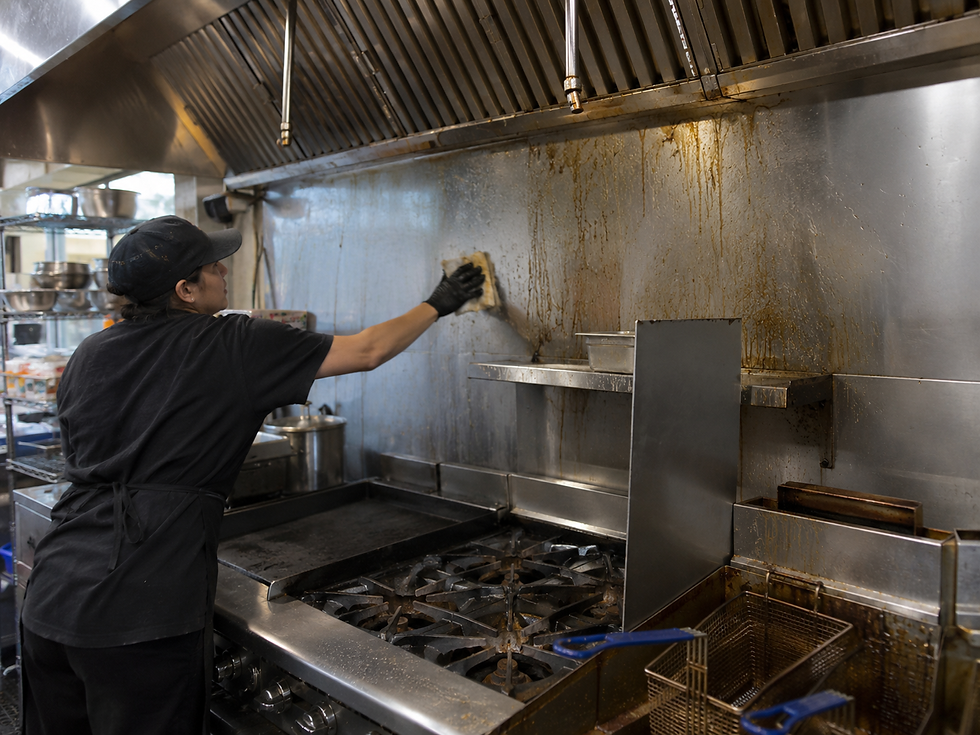
Kitchen floors that have grease should not necessarily be viewed only as a floor issue. Kitchen cooking areas, cabinets, countertops, exterior surfaces of appliances, and even reachable surfaces of hoods can harbor greasy accumulations. Should the rest of the kitchen continue to be heavily dirty, it will be increasingly hard to keep the floor clean.
Such a comprehensive cleaning process can be carried out in a rational order, such as starting with other surfaces and ending with the floor so that just-cleansed surface is not affected by the debris that is being swept away from other surfaces.
Such a comprehensive cleaning strategy would prove especially helpful to restaurants, cafes, bakeries, and workplaces that have cooking facilities.
Make Commercial Kitchen Floors Easier to Maintain
A commercial kitchen floor that remains greasy after mopping does not necessarily need to be mopped more often. The underlying issue may be accumulated grease, tracked residue, cleaning-product film, heavily used problem areas, or a combination of several factors.
Regular maintenance combined with periodic detailed cleaning can help businesses manage these problems more effectively. Starting with a cleaner floor also makes it easier for staff to maintain the space during everyday operations.
Railway City Carpet Cleaning provides professional kitchen cleaning for restaurants, cafés, bakeries, offices, food-service businesses, and other commercial spaces in London, St. Thomas, Tillsonburg, Ingersoll, Aylmer, and surrounding areas. If routine mopping is no longer enough to manage grease and buildup in your business kitchen, explore our professional kitchen cleaning services in London, Ontario for detailed attention to floors and other commonly affected kitchen surfaces.


Comments